

Understanding frontend and backend in a real context
The terms frontend and backend are often encountered in their earliest years, although it is difficult to comprehend the meaning behind them until one has done some building themselves. The simplest explanation for this lies in the consideration of a website as an entity which has two distinct components that work simultaneously.
The first component includes everything that can be seen or clicked upon by the user. The second one relates to everything else which happens invisibly to make this process feasible.
After grasping this idea, the difference becomes obvious.
What frontend development actually means
Frontend development is the part of a website you actually experience as a user. It’s everything that responds when you click something, scroll or type on the page.
You don’t really think about it while using a site, but every button press, menu opening or form you fill is handled by frontend code. It’s the layer that sits between you and how the website works.
As projects get bigger, developers often bring in tools like React or Vue to manage things better but the idea behind it is still the same.
What really matters in frontend is how natural and smooth everything feels when someone is using the website.
What happens on the backend side
Backend development can be understood as those aspects of web design that we cannot see but depend on whenever we use websites.
For instance whenever we login to any service, leave a message, perform a search query, open pages which load some information or perform any actions, backend development handles all those operations. It processes your actions, determines how the server should respond, communicates with the database and sends relevant information which appears on a webpage.
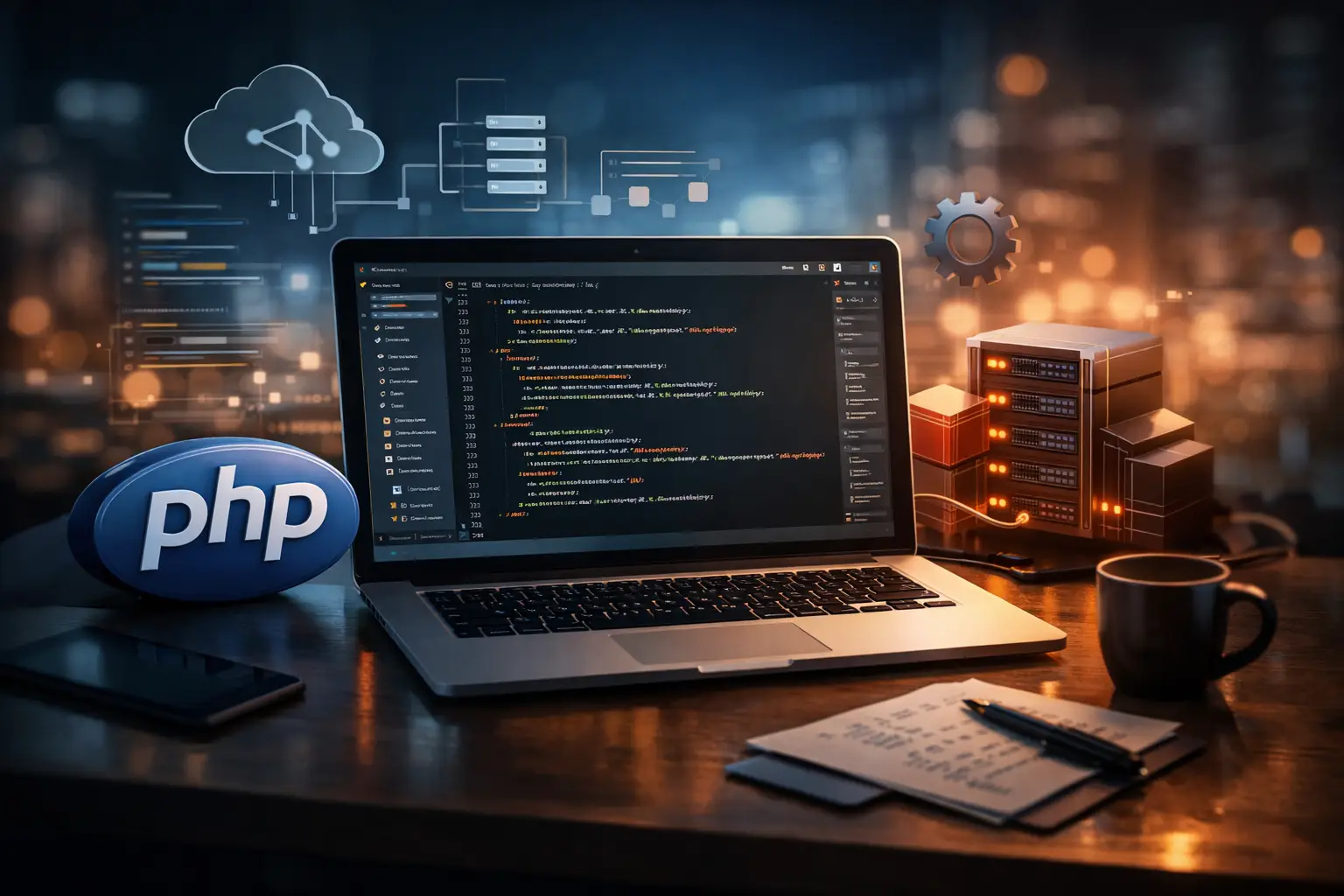
As for programming languages used by backend developers in practical tasks, those include PHP, Node.js, Python and Java as well as frameworks such as Laravel or Express which help to avoid unnecessary complications and write code more efficiently. Applications' data is usually stored in various databases which can be MySQL or MongoDB among others.
It does not get noticeable until something goes wrong and everything starts behaving awkwardly.
How both sides work together
Actually, the front and back ends are not distinct elements that operate independently. Instead, the two terms describe continuous interaction and dependency that are required for successful operation of any website.
For instance, a contact form is simply an interface where a client enters his/her contact data. However, from the viewpoint of back and front end integration, this means that the front-end element collects the data inputted by a client and passes it to the back-end element. In turn, the back-end processes the data and makes decisions about the actions that should be taken based on that input.
Such interaction between back and front ends is generally achieved via the use of APIs, which are actually mechanisms that allow interaction between back and front ends. Namely, the frontend sends a request and the backend answers with the required information.
In the absence of such connection between front and back ends, many contemporary applications and websites would become dysfunctional or unusable.
Choosing between frontend and backend
Each new developer eventually comes to the question of choosing the direction. The answer does not have to be immediate but it is always useful to know your inclinations.
Front-end development is suitable for those who appreciate beauty and pay attention to user convenience. With each change, you can immediately see its result which is incredibly motivating.
Back-end development appeals to those interested in logic and processing large amounts of information. This direction is related to the analysis of system behavior and the movement of data within it.
Both ways are equally good; they only require different approaches.
The idea of becoming a full stack developer
Others prefer to work with both front-end and back-end technologies which is referred to as full-stack development.
This approach provides some interesting benefits because it allows developers to develop their applications completely from the user perspective down to the architecture of the system itself. There is no need to stick with only one part of the application, giving developers greater flexibility when creating software.
However, learning both parts requires some effort which means that trying to absorb everything at once can be detrimental to the process. In most cases, it is easier for programmers to start from scratch and learn about the first technology thoroughly before moving to the other part of the application.
Common mistakes beginners make
A frequent misconception is that the frontend is simpler than the backend. On the contrary, there are difficulties associated with each field. For example, developing a neat and functional interface for various devices demands diligence.
Another misconception is being engrossed in theory instead of producing something practical. Tutorials can be useful but one should also engage in practice.
Moreover, people tend to switch between languages rather hastily. One must concentrate on fundamentals and consolidate knowledge.
A practical way to get started
If you’re just starting out, keep things simple. Begin with HTML, CSS and JavaScript. Make simple applications such as landing pages or even simple user interface elements.
Once you’re comfortable with that, go ahead and try making your frontend connect to a simple backend server application. The simplest example would be handling a form submission on a website.
Afterward, try out back-end programming languages like PHP or even Node.js, where you learn about data handling.
Sometimes the progress will be slow but consistency is more important than speed.
Making sense of it all
The frontend and backend developments are just different aspects of one thing. The former is all about aesthetics and the latter is all about functionality.
There is no need for you to have everything ready before you start. All that you should do is to just begin and make mistakes and create something useful.
In time, your taste and skill will naturally evolve.
A quick personal note from my experience
Choosing the right path took some effort from my side. I began with the basics and explored both frontend and backend before finally getting confident enough to make a choice.
But over time, I found myself more drawn to the processes taking place backstage and found pleasure in logical reasoning and working with real data, which enabled me to build the whole system for the application itself, thus making backend my choice.
Working with PHP and Laravel and other technologies gave me a better understanding of how applications are actually made and why performance and security are critical factors in that context. If you're interested in how PHP is evolving today, you can also take a look at what’s new in PHP 8.5.
Still, it was necessary to have even just basic skills of frontend development to be able to look at the bigger picture and collaborate effectively with others during the creation of full-fledged projects.
Every individual has his/her own unique journey and what works well for one does not necessarily mean anything to someone else, but that’s perfectly fine. The most important thing is to keep moving and discover something that brings joy into your life.